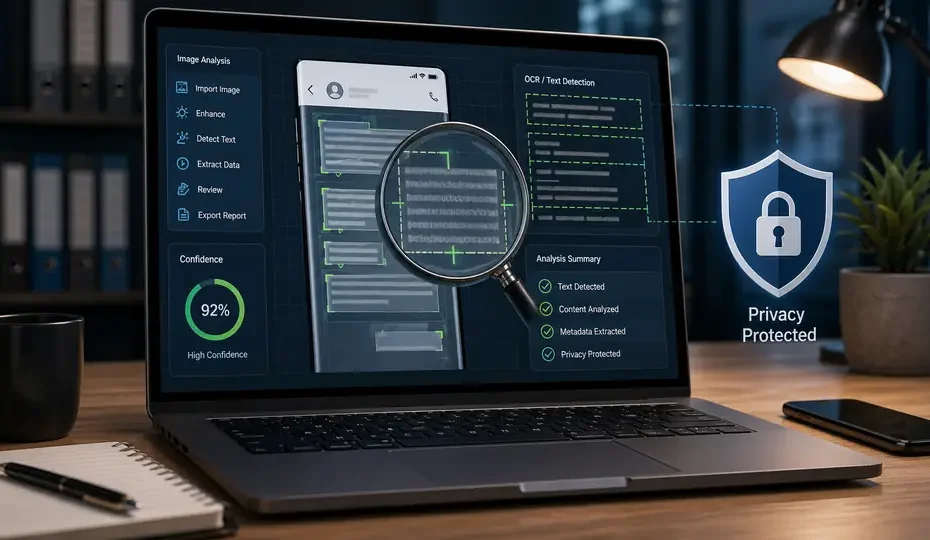
If you are searching for how to see hidden text in screenshot online, start with the most important truth: some hidden text can be extracted, but properly redacted text usually cannot be restored from a screenshot. The difference depends on how the text was hidden. Faint, low-contrast, cropped, or partially visible text may be readable with OCR or a clearer source image. Text covered by a solid black box, erased pixels, or true redaction is normally gone from the screenshot itself.
This guide explains what online tools can and cannot do, how to work safely with your own screenshots, when AI tools help, when they guess, and how to protect private information before sharing images. It is written for legitimate use only: your own screenshots, your own documents, authorized investigations, or recovery of information you are allowed to access.
What the Search Console data says
Your Google Search Console export shows this page already has traction: 10,047 impressions, 1,092 clicks, and an average position of 9.46 for the selected period. The main query, how to see hidden text in screenshot online, has 781 impressions at position 8.09. Related queries such as “uncover hidden text screenshot AI,” “see hidden text in screenshot online,” “uncover hidden text online,” and “how to uncover blacked out text screenshot online” are also getting impressions.
That data tells us the page should answer three questions faster and more clearly: Can hidden text be recovered? Which online tools are safe for your own screenshots? What should people do when blacked-out text is truly redacted? The rewrite below targets those needs while avoiding privacy-invasive advice.
Can you see hidden text in a screenshot online?
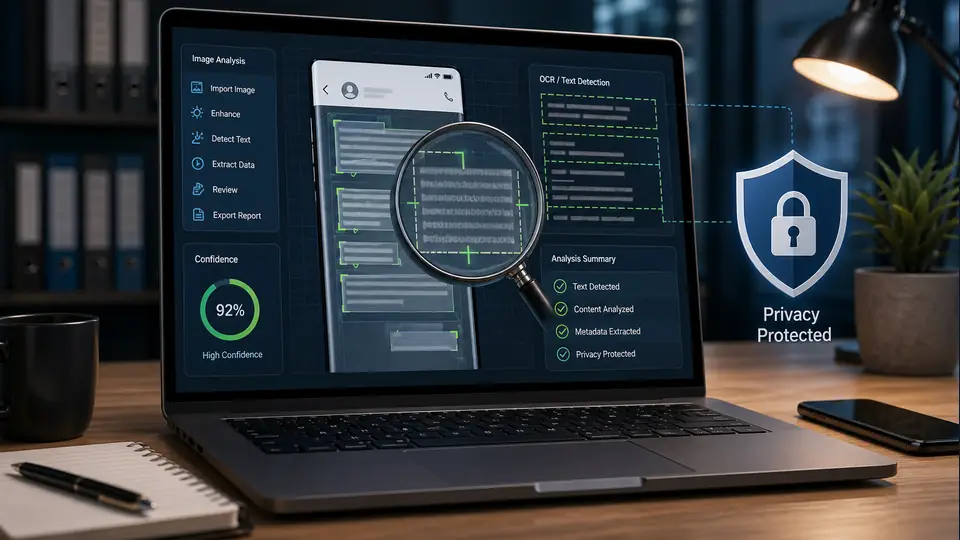
Sometimes. A screenshot is a flattened image, so it usually does not contain the original editable text layer. Online tools can only work with the pixels that remain in the image. If the letters are still visible, even faintly, an OCR tool may extract them. If the image is blurry but not fully redacted, an AI tool may help interpret the visible pattern. But if the text was covered by a solid shape, removed, or replaced with new pixels, there may be nothing left to recover.
Think of a screenshot like a photo of a printed page. If the writing is dim, small, or slightly covered, a better viewer may help you read it. If someone cut that section out of the page or painted over it completely, the missing words are no longer in the picture.
What online tools can reveal safely
When people ask how to see hidden text in screenshot online, they often mean one of several different problems. The safe answer depends on the type of image:
- Visible but small text: OCR tools may extract text if the letters are still present.
- Low-resolution screenshots: A higher-quality original screenshot or source file is usually better than an online enhancer.
- Faint or low-contrast text: Image viewers may make your own visible text easier to read, but they do not restore erased content.
- Cropped screenshots: The missing area cannot be recovered from the crop. You need the original image or source conversation.
- Blurred text: AI tools may guess based on visible shapes, but guesses should not be treated as proof.
- Blacked-out text: If the pixels were fully covered or removed, the hidden words are normally unrecoverable from the screenshot.
For your own screenshots, the safest path is to return to the original app, document, email, chat, or photo library and export a clearer version. That is more reliable than uploading sensitive screenshots to random online tools.
Why blacked-out text is usually gone
The query “how to uncover blacked out text screenshot online” has high impressions but low click-through in your data. This section deserves a direct answer: if a screenshot has a solid black box painted over text and the image was saved as a normal PNG, JPG, or WebP, the original pixels under that box are usually gone. An online tool cannot read pixels that no longer exist.
There are exceptions in some editable files. For example, a layered image, PDF annotation, or document with a text layer may still contain hidden data if the redaction was done badly. But a normal screenshot is normally flattened. Once the pixels are replaced, the original words are not stored underneath.
NIST defines redaction as removing information from a document or dataset for legal or security purposes. That same principle applies to proper redaction: sensitive information should be removed, not merely covered in a way that leaves recoverable data behind.
How AI tools help and where they fail
Searches like “uncover hidden text screenshot AI” perform well for this page, so the article should address AI clearly. AI tools can help with OCR cleanup, image description, and reading text that is still visible but hard to parse. They can also compare likely characters in a damaged or low-quality image.
But AI can hallucinate. If the text is hidden, erased, fully blacked out, or blurred beyond recognition, an AI result may be a plausible guess rather than a true recovery. That matters if the screenshot is being used for business, legal, academic, relationship, or security decisions. Never treat guessed text as evidence without the original source.
Use AI only on screenshots you own or are authorized to inspect. Do not upload private, medical, financial, intimate, school, workplace, or account screenshots to unknown tools. CISA mobile security guidance warns that exposed personal information can support phishing, identity theft, account takeovers, and other cyber threats.
Safe workflow for your own screenshots
If you are working with your own file and trying to recover visible text, use a privacy-first workflow:
- Find the original source. Go back to the app, website, email, chat, document, or photo where the screenshot came from.
- Export a clearer copy. Use the highest available resolution and avoid repeated screenshots of screenshots.
- Use built-in text extraction first. Many phones and desktops can copy visible text from images without uploading the file to a third-party site.
- Use OCR only for visible text. OCR is best for letters that are still present in the image.
- Avoid unknown upload sites for sensitive images. If the screenshot contains personal or account information, keep it local or use a trusted workflow.
- Do not rely on AI guesses as proof. If the result matters, confirm it against the original source.
- Ask for consent or a clean copy. If someone else owns the screenshot, ask them for the information instead of trying to defeat their redaction.
This approach is safer than trying to force a tool to reveal information that may have been intentionally hidden.
How to hide text properly before sharing a screenshot
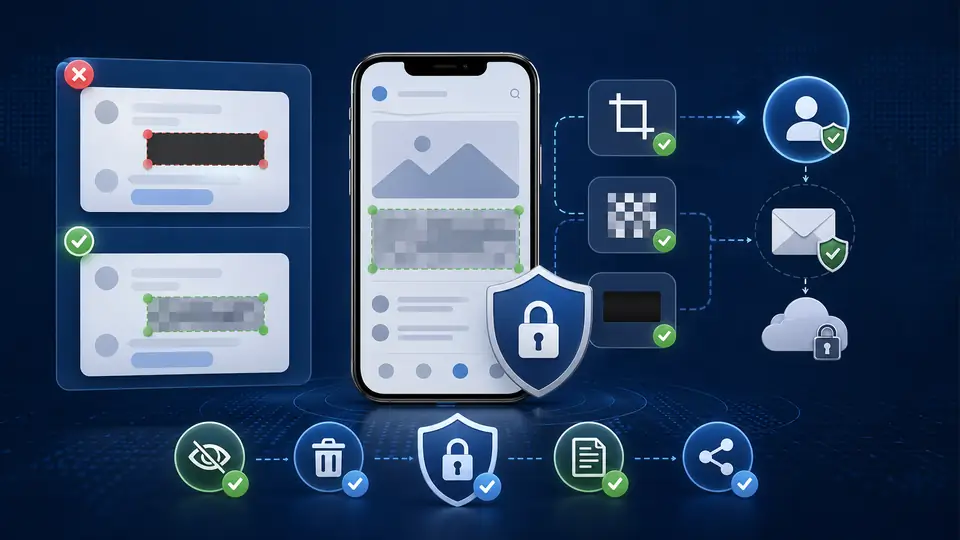
This page ranks for people trying to reveal hidden text, but the other half of the topic is prevention. If you are sharing screenshots, do not use a transparent highlighter, weak blur, or marker tool that leaves the original text visible. For sensitive content, crop the image, remove the private area, or use a proper redaction workflow.
Before sharing a screenshot, protect:
- Names, addresses, usernames, phone numbers, and email addresses.
- Account numbers, order numbers, ticket IDs, and transaction details.
- School, medical, legal, and workplace records.
- Private messages, photos, and relationship content.
- QR codes, barcodes, recovery codes, and verification codes.
- Browser tabs, URLs, bookmarks, notifications, and background apps.
The FTC recommends protecting personal information online and limiting unnecessary exposure. CISA also warns that personal information can be used for phishing and identity theft. Screenshots often reveal more than people realize, including notifications, tabs, profile photos, and file names.
When to get expert help
If a screenshot is part of a fraud case, workplace issue, account takeover, cyberstalking concern, or legal dispute, avoid uploading it to random online tools. Preserve the original file and document where it came from. A digital forensics professional can help review metadata, file history, source devices, and chain of custody without altering the evidence.
For authorized investigations, see our digital forensic investigation retainer. If the screenshot is tied to a hacked account, read safe account recovery help. If the issue involves suspicious phone activity, start with signs your phone is hacked.
Conclusion
The honest answer to how to see hidden text in screenshot online is that it depends on the pixels that remain. OCR and AI tools can help read visible, faint, small, or low-quality text. They cannot reliably recover words that were truly blacked out, erased, cropped away, or properly redacted. If privacy is involved, respect the redaction and ask for permission or a clean source file.
For your own screenshots, start with the original source, use trusted local text extraction, and avoid uploading sensitive images to unknown tools. For legal, fraud, workplace, or security matters, preserve the original image and get authorized forensic help instead of relying on guesses.
FAQs
Can I uncover blacked-out text in a screenshot online?
Usually no. If the black box replaced the original pixels in a flattened screenshot, the text is gone from that image. Online tools can only analyze pixels that still exist.
Can AI reveal hidden text in a screenshot?
AI can sometimes help interpret visible but unclear text. It cannot reliably restore text that was erased, fully covered, cropped out, or properly redacted. AI guesses should not be treated as evidence.
What is the safest way to read text from my own screenshot?
Go back to the original source, export a clearer copy, and use built-in text extraction or trusted OCR for visible text. Avoid uploading sensitive screenshots to unknown online tools.